- Published on
Park Bench: The Specs Behind the Seat Everyone Shares
- Authors

- Name
- Outdoor Wooden Bench
A park bench is the seat most people meet. In a single day, more people sit on one than on any bench in a private yard.
It does a plain job. It gives you somewhere to sit, for free, beside whoever else turns up.
That is the whole brief. Every number on a park bench follows from it.
This piece is about that bench. It looks at how the maker puts it together, why the wood lasts, and what to borrow for home.
It is also the model for a lot of wooden benches sold today. It is the outdoor bench most people picture when they hear the word. Learn its numbers once, and the rest get easier.
A short history of the shared seat
The park bench is a 19th century idea. Before that, a seat in town belonged to an inn or a private square.
Big public parks changed that. From the 1850s, cities like New York built large green spaces for everyone.
Central Park opened in 1858. Its designers, Olmsted and Vaux, planned for seating from the start.
They wanted every class to mix in one place. A long row of benches was the simplest way to do it.
Those early benches lined the walks. You could sit for free, for as long as you liked, and watch the crowd go by.
That is still how a park works today. The seat is the one part of a park that asks nothing of you.
Other cities followed New York. London, Paris and Berlin laid out parks of their own, and each one filled them with benches.
The bench traveled with the idea of the public park. Wherever a city built a green square, a row of seats came with it.
The bench also had to survive. It sat in rain, took heavy use, and saw little care.
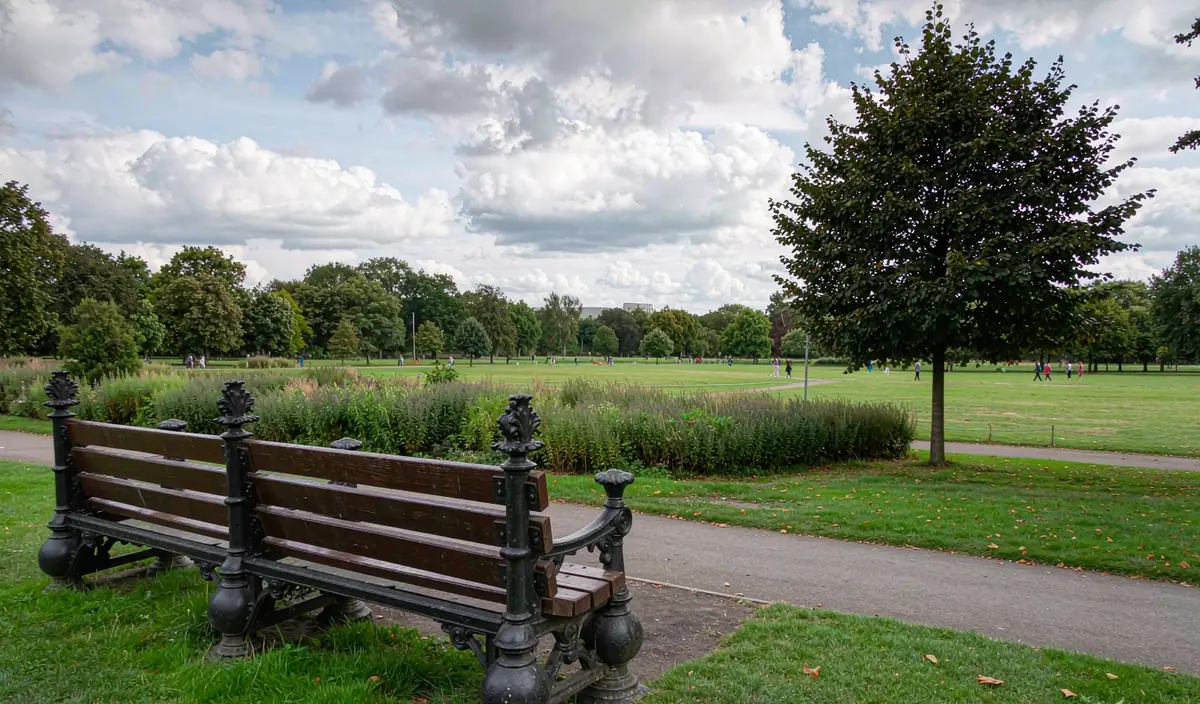
Cast iron solved that problem. Victorian makers bolted wooden slats onto cast iron ends, and the pattern stuck.
The cast iron end is still the mark of a classic bench. It is cheap to cast, hard to steal, and heavy enough to stay where it lands.
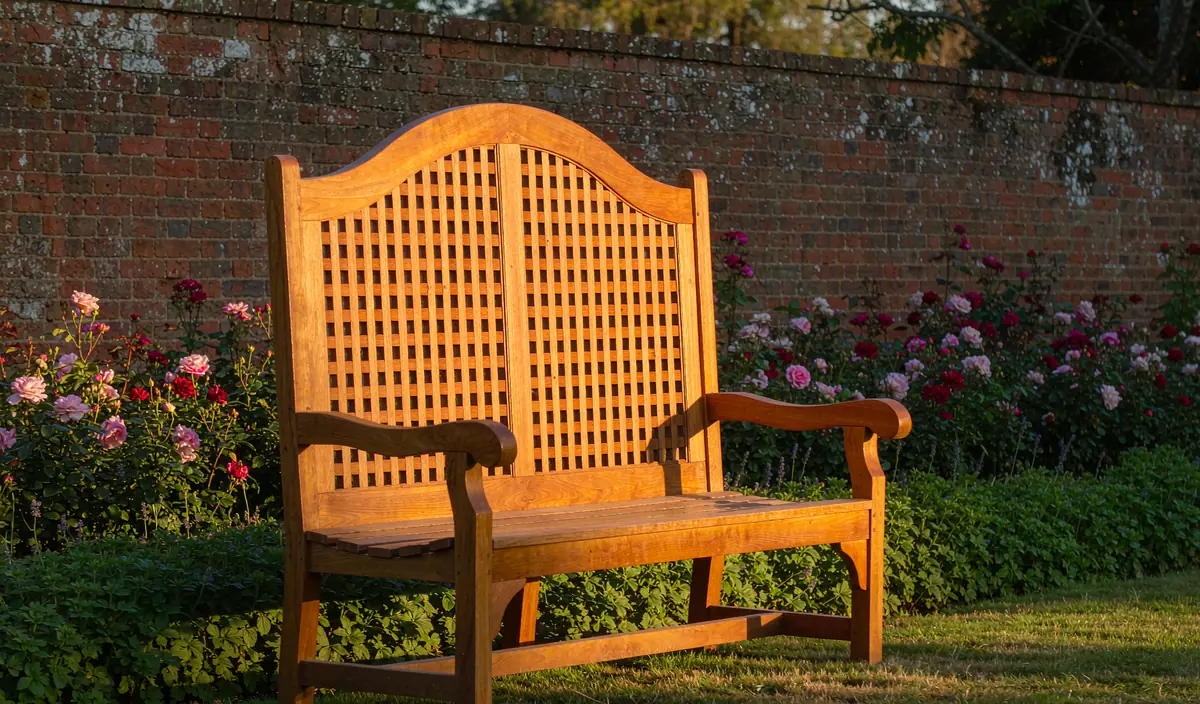
The other famous shape is the Lutyens bench. Sir Edwin Lutyens drew it for an English garden more than a hundred years ago.
It has a pierced back and wide arms. It is a garden bench at heart. Parks borrowed the look, so the name spread.
So two lines of bench came out of the same years. One is the public bench, plain and tough. The other is the garden bench, softer and more shaped.
The anatomy of a park bench
A park bench looks simple. Every part of it earns its place.
Start with the seat height. It sits about 17 to 18 inches off the ground. That is chair height, and it suits most adults.
Seat depth runs 18 to 20 inches. That is deep enough to sit back and shallow enough to stand up from.
The slats are the heart of it. A bench seat is a row of narrow boards with a small gap between each one.
The gaps do three jobs. Rain runs through them, air dries the wood, and grit falls out.
Count the slats on a bench you know. Five or six is common across the seat.
Each slat runs 1 to 2 inches wide. Thin slats flex, so they feel soft under you.
Good slats also have a rounded top edge. A squared edge digs into the back of your legs after a few minutes.
Thicker slats last longer. Public benches often use boards an inch and a half or more.
The back repeats the seat. Two or three slats run across the end frames, with the same gap in between.
A lower rail carries the seat. The slats rest on it, and it stops them bowing in the middle.
Length sets the seats. A 4-foot bench holds two people. A 6-foot bench holds three, with room to spare between them.
Here are the numbers that matter, in one place.
| Part | Common size | Why |
|---|---|---|
| Seat height | 17 to 18 in | Same as a chair |
| Seat depth | 18 to 20 in | Sit back, still stand up |
| Slat width | 1 to 2 in | Thin flexes, thick lasts |
| Slat gap | About 1/4 in | Drain and dry |
| Arm height | 8 to 10 in over the seat | Adult arm, keeps a child in |
| Back angle | 10 to 15 degrees | Right for a short rest |
The arms sit about 8 to 10 inches above the seat. That suits an adult arm, and it stops a child sliding off the end.
The back leans a little. Around 10 to 15 degrees off upright feels right for a short rest.
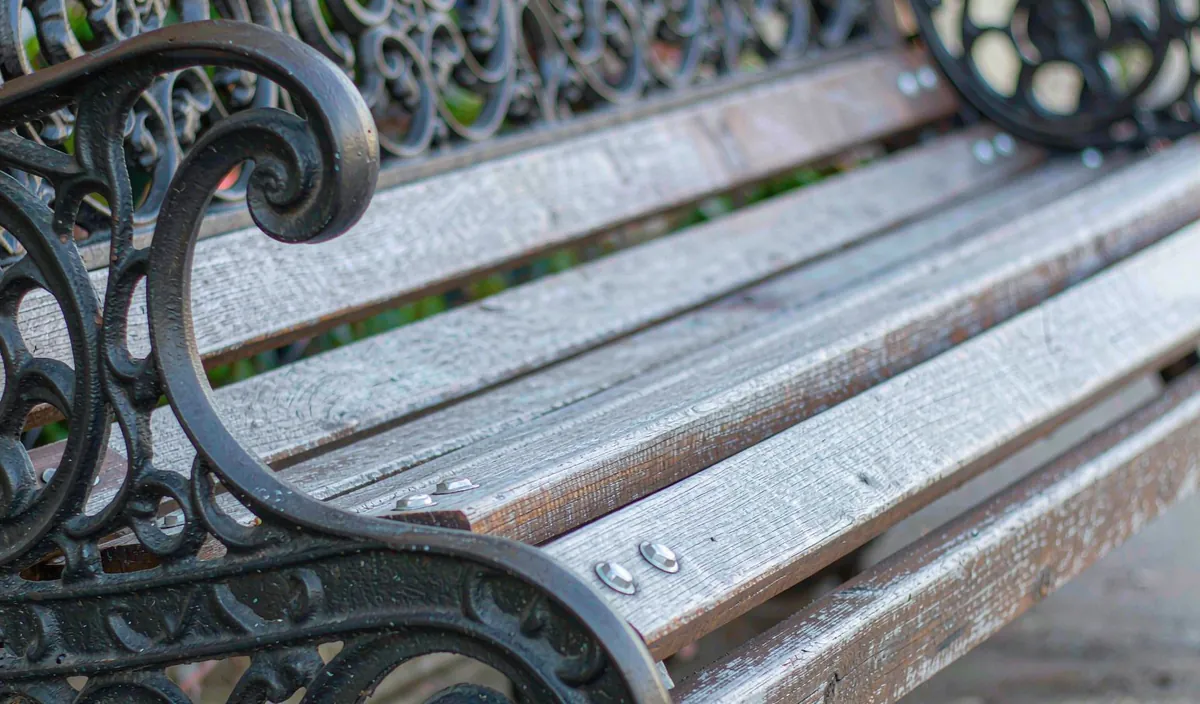
The end frames carry the whole seat. On a classic bench they are cast iron, and the slats bolt through them.
Cast iron is heavy on purpose. Weight holds the bench in wind and puts thieves off.
The ends also splay out at the bottom. A wide base stands steady on uneven ground and spreads the load.
Look under an old bench. You often find a small gap along the front rail. That gap drains the seat and keeps water off the frame.
The bolts matter too. A bolt you can undo is a slat you can replace.
Why hardwoods win in public
A bench in a park takes a beating. It sits in the rain, people climb on it, and a crew visits once a year at best.
That rules out soft woods. Pine and cedar are fine at home, where someone can oil them. In a park, they rot or wear through too fast.
So public benches go to hardwood. An outdoor wooden bench gets no shelter here, so the wood carries the job alone. Oak, iroko and teak do most of the work.
Iroko is the common one. It is an African wood that looks like teak and costs less. It shrugs off rot and insects, and it needs no finish.
Teak is the top pick. It holds up in full weather for decades with no oil at all. The catch is the price, so parks save it for their best seats.
Oak is the traditional choice in Britain. It is strong and easy to find, but it wants a finish to stay sound.
The iron ends are a different story. Cast iron does take paint, and a fresh coat every few years keeps rust away. That is why old benches often show dark green or black ends under bare wood.
The wood types guide ranks the whole field for weather.
The real lesson is not the species, though. It is the finish, or the lack of one.
Parks leave hardwood bare. Bare wood turns gray, and gray is fine. It is a surface change, not rot.
A finish needs redoing every year or two. A crew with a thousand benches cannot do that. So the bench goes bare, and the wood survives on its own.
That is the trade. You give up the fresh brown look, and you get a bench that looks after itself.
Hardwood also takes a knock better. It dents instead of splintering, and a dent is easy to live with.
Wood also stays cooler in the sun and warmer in the cold. That is why a wooden bench gets sat on when a metal one sits empty.
One more thing about wood. The cut ends of a board soak up the most water. A park bench hides those ends inside the iron frame, where they stay dry.
What to borrow from the public spec
You do not need a park bench’s weight or cost. A few public habits are still worth copying.
Pick slats at least 1 inch thick. Thin boards feel cheap and cup over time. An inch holds its shape.
Use bolts that will not rust. Stainless steel or hot-dip galvanized bolts cost a little more and last the life of the bench. Plain steel turns to orange dust in a season.
Choose a bench you can take apart. If the slats bolt on, you can swap one worn board instead of the whole seat.
Lift the feet off the ground. Small rubber or metal feet keep the cut ends out of the wet.
Let the seat drain. Slats with gaps do this for free. A solid top holds a puddle.
Go heavier than you think. Weight is what holds a bench down in wind.
That is the public spec in six lines. None of it costs much. It is mostly about choosing the plainer option.
Six rules like that will cost you an hour and a few dollars. They are the difference between a bench that lasts five years and one that lasts twenty.
The frame is the part that lasts. Iron ends outlive slat after slat, so a good set can take three rounds of boards. That is the real economy of the design.
At home you can add one thing a park cannot. A cushion. A park bench trades comfort for survival, but a bench in a garden can have both.
A bench in the woods
A bench in woods has one job. It has to hold a tired walker.
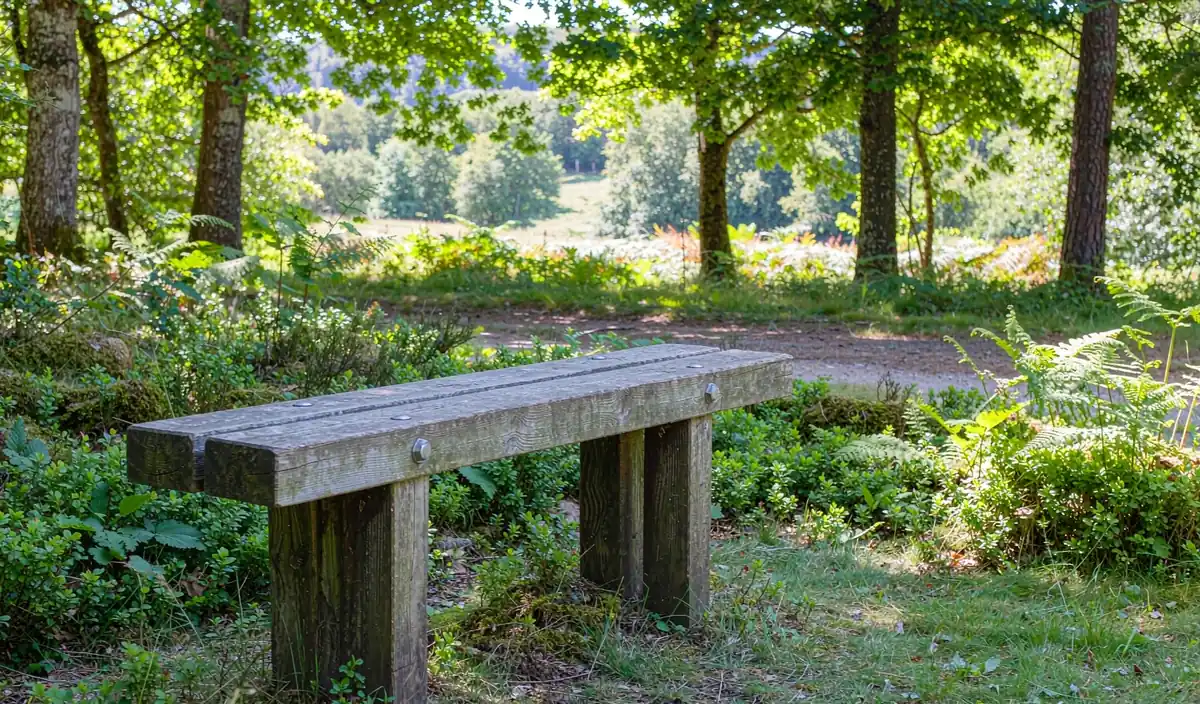
This is the plainest bench for outside there is. It is the plank at the end of a trail, or the seat at a viewpoint halfway up.
A trail bench gets almost no care. Nobody oils it. Nobody washes it.
It just has to hold. So the design drops to the basics. A plank, two legs, and enough height to sit clear of wet ground.
Two things shorten a trail bench more than use. Wet feet and deep shade. Ground that stays wet rots the feet first, and a bench in shade dries slowly.
Trail crews use whatever hardwood is local and cheap. In many forests that is oak or a dense pine.
The wood does not have to be fine. It has to be hard.
The crews skip the finish on purpose. A raw board dries fast after rain. A coated board can hold water under a cracked film and rot from inside.
They also leave the seat open. Gaps between the boards drain the rain before it pools.
The site matters more than the build. Put a bench on a flat patch, never in a dip. Water follows the ground, and a bench in a low spot sits in it.
Face the bench at something. A trail bench earns its place by looking at a view, a stream or a clearing.
You will not see a padded bench on a trail. Cushions soak up water and go home with someone. A hard seat survives the weather.
Then expect it to turn gray. Gray wood in the open is a stable surface. Left alone, a hardwood bench can hold for twenty years.
The lowest-care bench is often the longest-lived one. Doing less is the point.
Bringing the park look home
Park style is easy to bring home. The look is a wooden park bench on dark metal ends, and makers sell both parts.
You can buy cast iron end frames on their own. They come in the classic patterns, and you add your own slats. That lets you pick the wood and the length.
Garden centers and online hardware sellers carry the ends. Look for a pair drilled for standard slats, so any board will fit.
A bench built this way is heavy. Cast iron ends weigh more than a wooden frame of the same size.
On a patio that weight is fine. On a balcony, check your limit first.
You can also scale it down. A 4-foot bench seats two and fits a small garden. A 6-foot bench seats three and wants a bigger space.
The end frames set the width, so pick the frame to match the spot. If you are still working out a size, the picking guide starts with the numbers.
Then match the wood to the frame. Dark metal ends suit a warm hardwood. Teak, iroko and oak all read as a classic bench.
Pick a plain edge on the slats. A molded edge looks busy against the simple iron ends.
The shape is not the problem. These patterns are more than a hundred years old, so they are free to copy.
The name is the one trap. Building a Lutyens-style bench is fine. Selling one under another maker’s name is not.
One warning about weight. A cast iron bench is not one you move often. Put it where it will live.
The build is simple, too. A drill, a wrench and a saw will do it. You can assemble the whole bench on the patio.
Two details that surprise people
Two small things about park benches still catch people out.
The first is a bump on the seat. Some city benches carry a small metal bar or a raised divider in the middle.
It is not a handle. It stops skateboarders using the bench to grind. One bar saves a seat from a lot of damage.
The second is the plaque. A small plate on the back of a bench often carries a name and two dates.
People pay for a bench, or a single slat, to remember someone. It is one of the quiet ways a park pays its bills.
Questions people actually ask
How wide is a park bench?
Most run 4 to 6 feet. A 4-foot bench seats two people, and a 6-foot bench seats three.
How high is a park bench seat?
About 17 to 18 inches, the same as a dining chair. That height suits most adults.
Why do park benches have gaps between the slats?
The gaps drain the rain, dry the wood and drop grit. A solid seat would hold a puddle.
What wood do park benches use?
Hardwood, mostly. Oak, iroko and teak win because they take heavy use and little care. The wood types guide covers the rest.
Do park benches need treating?
No. Public benches stay bare and go gray. An oiled bench looks browner, but it wants a fresh coat every year.
Can a park bench work in a home garden?
Yes. The style suits a lawn or a path as well as a city park. The garden bench guide covers where to put it.
Can I put a park bench on a patio?
Yes, if the weight suits the space. A cast iron bench is heavy and stays put. The patio bench guide covers layout.
How heavy is a park bench?
A cast iron and wood bench can run 100 pounds or more. That is why you place it once and leave it.
The short version
A park bench is a plain seat built to last without care. Its numbers are old and well tested.
The seat sits about 18 inches up. The slats leave gaps so rain runs through. The wood is a hardwood, left bare to go gray.
You can copy all of it at home. Use thick slats, bolts that will not rust, and feet that lift the wood off the ground.
Do that, and your bench will last years with nothing more than a wipe.