- Published on
Patio Storage Bench: What to Store, What to Avoid and Which Wood Lasts
- Authors

- Name
- Outdoor Wooden Bench
A patio storage bench does two jobs. It is a seat on top and a box underneath. The seat is the easy part.
The box is where things go wrong. Seal it tight and it grows mold by August. Leave it open to the rain and everything inside is wet by October.
Almost every complaint about a patio storage bench sits between those two.
If you want to know about the seat - size, depth, layout - the patio bench guide covers it. This piece is about the space underneath.
What people actually store
Ask ten owners what they keep inside and you get four answers. Cushions, tools, toys and charcoal, usually in that order.
Cushions take up the most room. Fold a pair of seat cushions flat and they fill about a third of a four-foot box. They are also the reason most people wanted storage in the first place. If yours live in the box, the box is the thing most likely to ruin them.
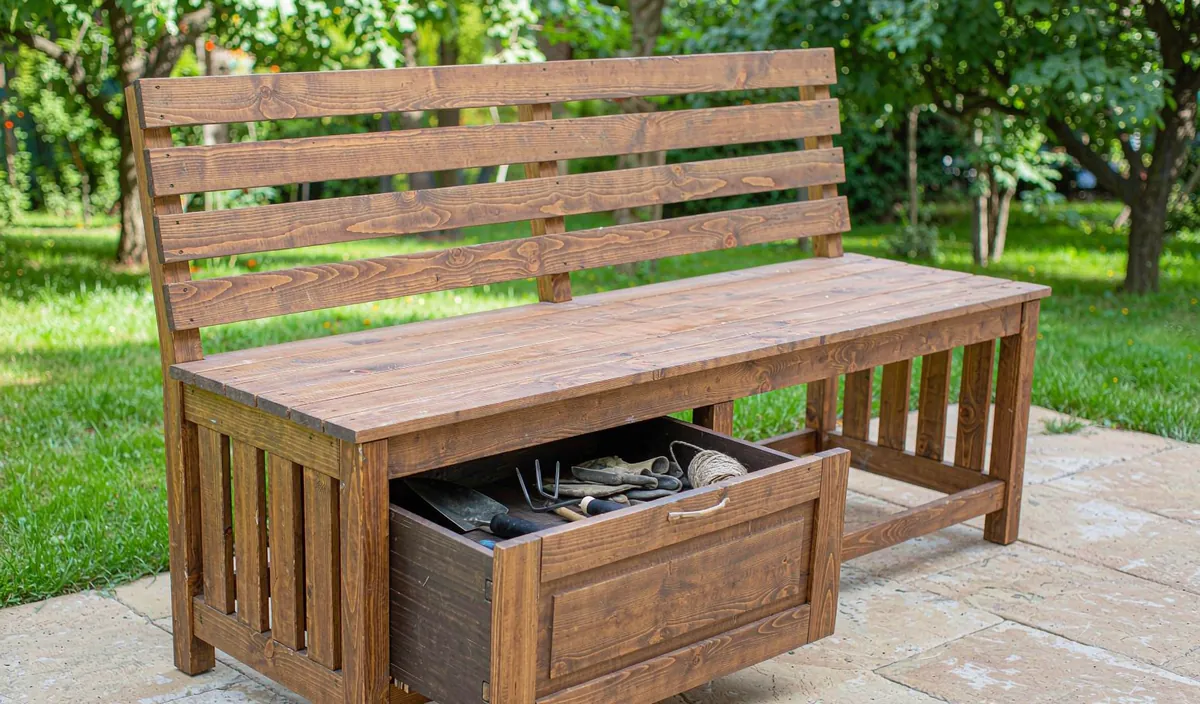
Hand tools are always in there. A hand trowel, a small fork, pruning shears, string, a pair of gloves. They are small, light, and you use them every few days. That is what makes a box next to your work worth having.
Toys are why these benches sell. Balls, buckets, chalk, a bubble wand, the plastic thing that broke in June. A storage bench is a toy chest with a lid you can sit on. That is closer to the truth than most product pages admit.
Charcoal and grilling tools. These need to stay dry and out of the sun. A box beside the grill saves a trip to the garage. Nothing else in the yard does this job as well.
The box has a season, too. Tools and toys live in it from spring to fall. The cushions join them in winter.
The changeover is the weak point. The box stands shut through the damp weeks of spring and fall, and nobody opens it. Moisture settles in, and that is when most of the damage happens.
Here is the honest picture on space. A four-foot bench usually holds three to four cubic feet inside. That sounds like plenty, until the cushions go in.
The box on my own bench holds one folded pair of cushions and a trowel. Everything else I meant to store in there lives in a bucket beside it.
What not to store
Anything already wet. A damp cushion in a closed box is the fastest way to ruin the cushion and the box together. Dry it first. If it will not dry, do not put it in.
Birdseed and grass seed. Mice and rats find a closed box on a patio quickly, and seed is an invitation. The same goes for open bags of potting soil, which also stay wet forever.
Any kind of fuel. Lighter fluid, propane tanks, spare matches. Heat, fumes and a closed wooden box do not belong together. The material does not change that.
Soil and potting mix. Heavy, wet, and it never dries in a closed space. The bench is not a shed. Treat it like one and the bottom board will rot out.
Batteries, chargers and anything electronic. Patio temperatures swing from hot to cold. Moisture inside a box hurts electronics more than rain outside it.
A hose. A hose never dries inside a box. It keeps everything else damp, and it takes up half the space while doing it.
The point behind all six: a storage bench is for dry things that are already dry. It is not a drying room.
Honestly, that one rule saves more cushions than any cover or coating does.
How the box opens
Work out which of the three designs you are buying. They look the same on a product page. They behave differently once you own one.
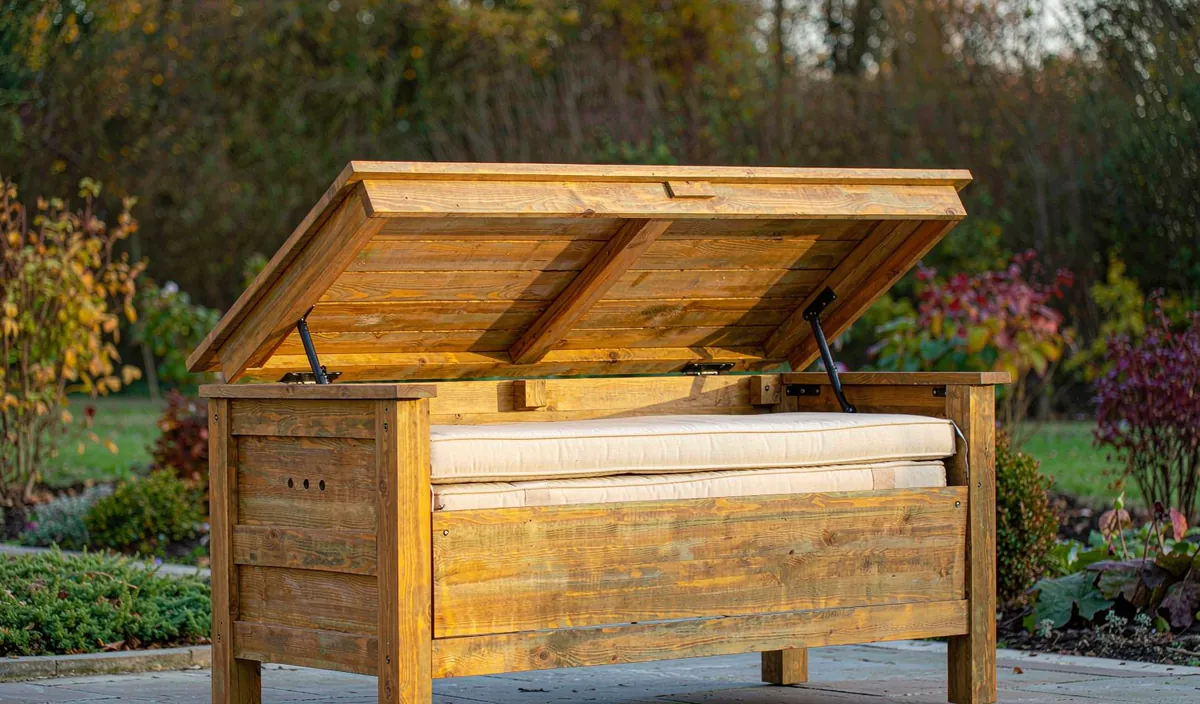
A flip-up seat, where the seat is the lid. This is the classic design, and you get the most space for your money. It is also the most awkward one. You cannot sit on it and reach inside at the same time.
Fill it with cushions and every trowel means lifting the whole seat. Fine once a week, annoying twice a day.
A drawer or door at the front. The seat stays put and you pull the storage out from the front. This suits tools better. What you want sits at the front, and the seat stays clear.
The catch is depth. A drawer needs rails and room to slide. The same frame with a flip-up seat holds more.
A door on hinges at one end. This one is rare, and worth knowing about. It works like a big storage chest, and the whole seat stays usable. It also suits narrow boxes, where a drawer would be too shallow.
So which one fits how you use it? Toys and cushions once a season point to a flip-up seat. Tools you reach for every other day point to a drawer.
Wood choice and ventilation
The biggest design flaw in a storage bench is not the wood or the hinges. It is air. More exactly, it is the lack of air.
A storage bench is a box with a lid, sitting outside. Wood moves with the seasons, and the air inside does not move at all. Whatever damp goes in stays in.
That damp comes off a cushion, off a wet trowel, or out of the air on a foggy morning. A closed box holds the humidity it started with. It stays there all season.
Look for four things before you buy. They matter more than the wood type.
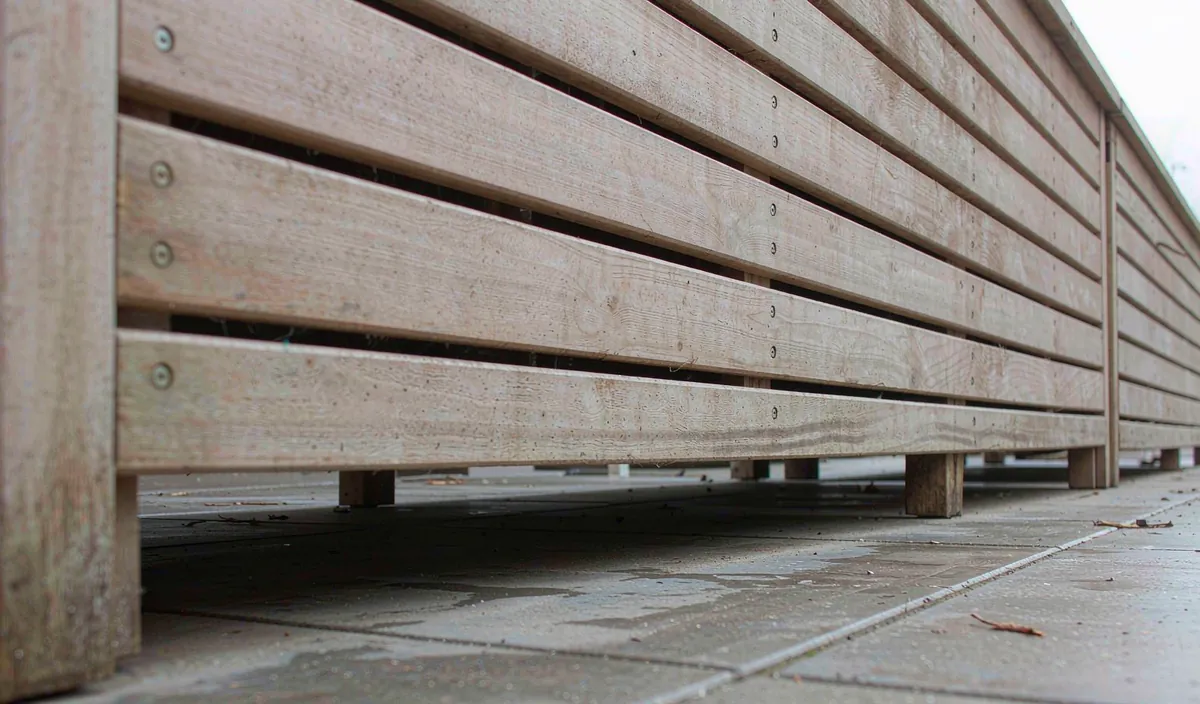
A slatted bottom, or a raised floor. Gaps let air move under your things. A solid board lying flat on the ground is just a tray that holds water.
Feet that lift the box an inch or more off the ground. Where wood touches the ground, water creeps up and rot starts. Sit a box flat on the paving and it will draw damp all winter.
A gap under the lid. It does not need to be big. An eighth of an inch along the front edge lets the box breathe without letting rain in. Some makers hide it as a decorative shadow line.
Cedar lining or cedar slats, if you can find them. Cedar has lined storage chests for years, for good reasons. It smells good, and it resists rot and insects. It also slows the musty smell a closed box gets.
It helps, but it is not a fix. It will not dry out a box that is already wet.
The wood matters on an outdoor wooden bench, but a box changes the order. The inside is dark, damp and still. Rot-resistant woods move up the list, and cedar gets a bump for its smell.
Teak and iroko are the ones you can forget about. Cedar and white oak are the sensible middle, and acacia is fine if the boards are thick enough. The wood types guide compares them all, so there is no point repeating it here.
One thing worth saying plainly. If the box has no vent, a lid with a rubber seal and a solid floor, you have not bought storage. You have bought a mold farm.
Hardware that survives
Hardware on a storage bench wears out sooner than hardware on a plain bench. A hinge on a lid works much harder than a joint that never moves. Four details decide how long yours lasts.
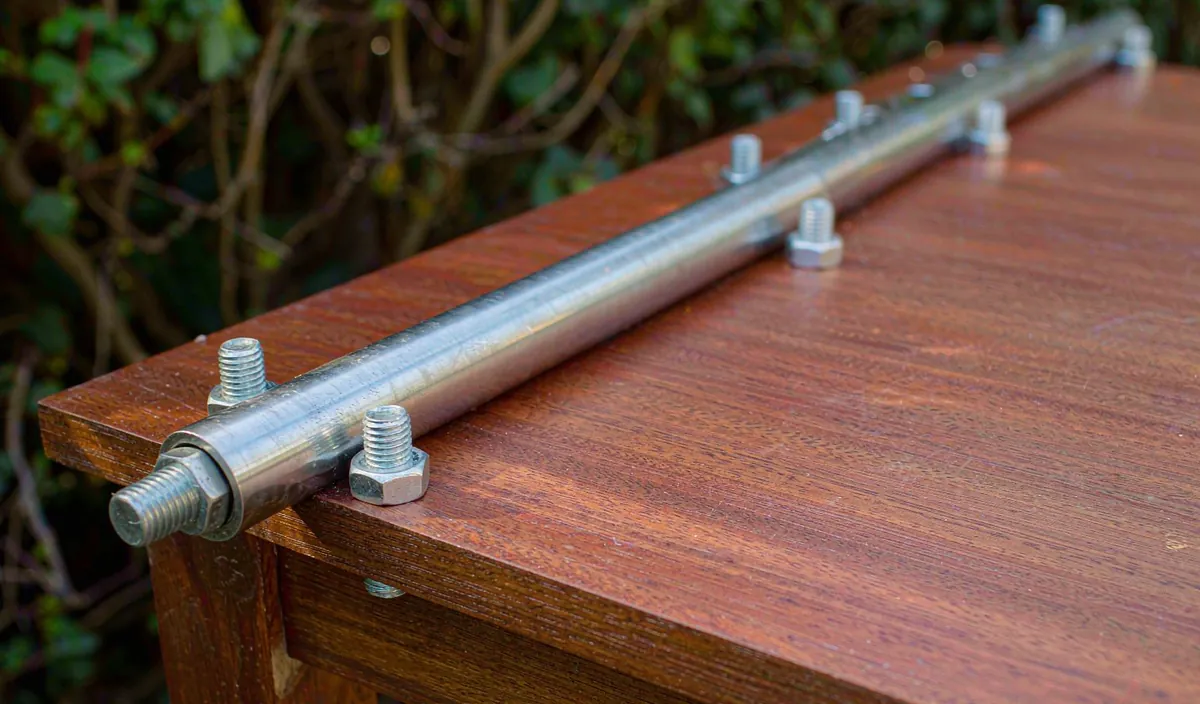
Hinges that bolt through the frame, not into the cut ends. Screws pull out of cut ends first. A hinge that bolts through the frame will outlast the wood around it.
One long hinge instead of two small ones. A lid is a long lever. A hinge that runs the full width spreads the load along the back edge. Two small plates take all of it in one spot.
Stainless steel or galvanized screws and bolts. Ordinary steel rusts, and within a season or two you get orange streaks down the front of the box. This is the cheapest upgrade on the whole bench.
On a bench I checked last spring, the plated screws showed orange streaks after about fourteen months. The stainless bolts beside them were still clean.
Soft-close, if you like it and know it wears. A soft-close hinge is something you will replace one day. It is lovely in year one. Do not turn down a good bench just because it has one.
A heavy lid you have to hold open with one hand is the most common complaint about cheap storage benches. A gas strut fixes it, like the one that holds a car trunk open. A simple prop does too.
If you are buying, check two things. Does the lid hold itself up? And do the hinges bolt through the frame?
Leave a finger’s width of space where the lid meets the box. Feel the front corners for a gap that can trap fingers.
Trapped fingers put people off a storage bench faster than anything else. So that gap is the one thing I would check first.
Getting the size right
The sitting size is the same as any patio bench, so the only new number is the space inside. Measure your cushions before you pick a length.
A folded pair is about the size of a carry-on bag. Two of those decide the box for you.
| Bench length | Seats | Inside, roughly | What fits | Best for |
|---|---|---|---|---|
| 3 ft | 2, snug | 2.5 - 3 cu ft | One set of cushions, hand tools | Small patios, by a door |
| 4 ft | 2 | 3 - 4 cu ft | Cushions, tools, a few toys | Most patios |
| 5 ft | 3 | 4 - 5 cu ft | Cushions, tools, toys | Families, bigger patios |
| 6 ft | 3, roomy | 6 - 7 cu ft | All of the above, plus charcoal and grilling tools | Large patios, used all year |
Two things about that table. The volumes are the useful space inside, not the outside size of the box. Makers quote whichever number looks better.
A deeper box is not always better, either. Past about 20 inches, you cannot reach the back without kneeling.
Longer or deeper? Take longer. Width is space you can use, and past a point depth is just where you lose things.
If the space itself is small - a balcony or a porch - the small wooden bench guide covers benches from 30 to 48 inches wide.
One thing people forget until delivery day: measure the route, not just the spot. A six-foot bench is heavy, stiff and awkward. You have to get it through a gate, around a corner and up a step.
If the route is tight, two three-foot benches will fit where one six-foot bench will not. Better still, one bench is a two-person lift. It is not a four-person argument.
Wood, resin or metal
All three work. They wear out in different ways, and that is the real choice. It is also why outdoor patio storage benches look identical in a photo and feel nothing alike after a season outside.
Resin and plastic. Light, cheap, never needs oil, and easy to move on your own. The problems show up later.
Sunlight makes the plastic brittle, and a big lid can bend out of shape. The color goes right through, so a scratch is permanent. You cannot repair a cracked box, only replace it.
Metal. Strong for its weight and usually thin-walled, so you get more room inside than wood for the same footprint. There are two catches, though.
A metal seat in July is unusable without a cushion. A sealed steel box also traps moisture inside, which is worse for cushions than an open wooden box.
Wood. Heaviest, needs some looking after, and the only one you can repair. You can re-oil it, tighten the screws, and replace the slats. That is the whole case for wood, and it is a strong one for a bench that stays outside all year.
The plain answer. Choose wood for all-year outside, and resin for a covered balcony. Choose metal for the most space in the smallest footprint.
When people see all three side by side, most walk straight to the wood one. The resin only wins when they have to carry it up a flight of stairs.
Whichever you pick, look at how the maker puts it together before you pay. The picking guide walks through what to check. A storage box has more joints that can go wrong than a plain bench.
Keeping the lid and seam alive
Almost all the care on a storage bench happens at the lid seam. That is where water sits.
Clear the seam. Wet leaves lying across the lid line for a month will find a way in. They stain the wood on the way in, too.
Check the hinges and the strut once a year. Bolts work loose, especially after a dry summer. Five minutes with a screwdriver in the fall is the whole job.
Oil the lid edges and the cut ends, not just the top. The cut ends of the lid do the most work and get the least attention.
Look inside in spring. If it smells musty in April, the air is not moving, and cleaning will not fix that. Add a vent gap, or stop storing cushions in it.
The box I opened last April had a gray bloom on one cushion. A trowel beside it had a rust line down the handle. Both went in dry the October before.
Treat the inside faces too. Most people oil the outside of a wooden bench and forget that the inside sits in the damp. Every couple of years, once the wood is dry, give the inside panels a thin coat. That is what stops the bottom board going soft first.
Questions people actually ask
Will a storage bench keep my cushions dry?
Not on its own. It keeps the rain off them. Whether they stay dry depends on the air moving through, and on whether they went in dry.
How much does a patio bench with storage really hold?
Three to four cubic feet on a four-foot bench. That is one set of folded cushions plus tools. A six-foot bench roughly doubles it.
Is a cedar lining worth the extra money?
Yes, on a box that already lets air through. No, on one that does not. Cedar slows the smell, it does not remove moisture.
Wood or resin for a storage bench?
Wood if it stays outside all year and you want to keep it. Resin if it lives under cover and you will move it around.
Can I leave cushions in it over winter?
Only if they are completely dry, the box lets air through, and you check once in midwinter. Otherwise take them indoors and leave the box empty.
Do I need to anchor a storage bench?
A wooden one rarely. A light resin one on an open patio will move in a strong wind. Anchor it into the paving, never through the wooden feet.
Do storage benches have a weight limit?
The seat does, usually 500 pounds or more. The box does not. Fill it to the lid with soil or tools, and the bottom board will bow within a season.
Can a storage bench go in a garden instead of on a patio?
Yes. The box works the same way on an outdoor bench, patio or lawn. The garden bench guide covers where to put it.
The short version
A storage bench is worth owning for one reason. It puts the things you use next to the place you use them. No shed does that.
Buy it for the box, not the seat. Check for a slatted floor, feet that lift it off the ground, a gap under the lid, and stainless hardware.
Those four details decide whether it still works in year three. Everything else is about how it looks.